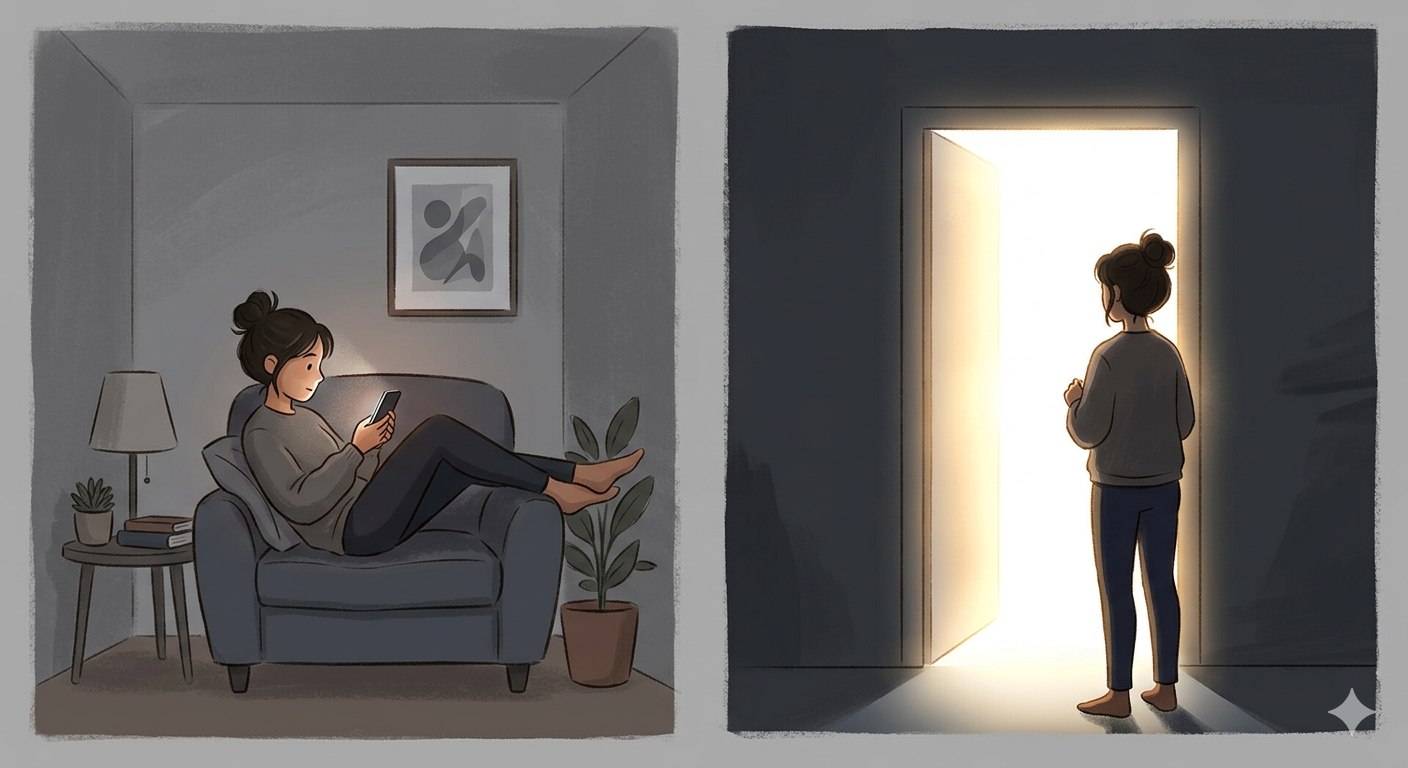
Every hidden gap is a truth you made up and stopped questioning
I was reading StoryWorth when I saw it.
Not one story. All of them. Every hidden gap is a story we tell ourselves — a truth we constructed, then stopped looking past. We like the status quo. If you’re satisfied, or at least safe in what you can see, most of us are fine staying there.
Until everything piles up.
Your world gets smaller. You start judging — others, yourself, the situation. And you realize: you’re not actually safe. You’re just predictable. You know what happens next because nothing is happening at all.
That’s when the gap becomes visible.
The moment you see it, unpredictability starts.
Anything can happen. That’s exciting. That’s also terrifying. Because now you have a choice: act, or retreat back into the predictability you just outgrew.
The story can be about anything.
You keep a family relationship the same because that’s a reality you can handle. But the relationship has already changed — you just haven’t checked in. You haven’t been curious about how it could develop. So instead of growing together, you grow apart. Silently. Predictably.
Or you became a control freak instead of living in trust with your surroundings. You didn’t decide to become that person. You just kept tightening your grip, one small thing at a time, until control became your baseline and trust became the risk.
Or there’s a product you want to develop. But you stay safe in your job. The gap isn’t about time or resources. It’s about the story you’re telling yourself: “I’m not ready yet. I need to learn more first. Maybe next year.”
Next year, the story will be the same. Just with different words.
Here’s what I realized reading those stories:
Every gap is a threshold between two versions of your life.
On one side: you let life happen to you. You’re an NPC in your own story — reactive, predictable, safe. You know your lines. You stay in your lane.
On the other side: you become your own hero. Not in the motivational poster way. In the “I saw the gap and I didn’t look away” way.
The gap doesn’t care what the content is. Family relationships. Career moves. How you spend your evenings. Whether you trust people or control them.
The gap only cares about one thing: are you willing to look?
Because the moment you see it — really see it — unpredictability begins. You can’t unsee it. You can’t go back to the old story and believe it the same way.
You can stay in it. People do. But now you know you’re choosing it.
That’s the difference.
Before you see the gap, you think you don’t have a choice. The story feels like reality. “That’s just how our family is.” “That’s just how I am.” “That’s just how it works.”
After you see the gap, you realize: the story was never reality. It was just the truth you made in your head so you wouldn’t have to keep looking.
And now you’re looking.
So what happens next?
I don’t know. That’s the point.
Once the gap is visible, anything can happen. You might check in with that family member and discover a completely different relationship is possible. You might release control and find out trust was available the whole time. You might start building that product, or realize you don’t actually want to.
The stories in StoryWorth weren’t teaching me about hidden gaps.
They were showing me that every story we tell — about ourselves, our relationships, our choices — is either closing a gap or keeping one hidden.
Win2All isn’t a new idea. It’s just naming what stories have always been doing: making the invisible visible.
Now go find what I missed.
Not in this essay. In your own story.
Where are you staying safe in predictability? Where has your world gotten smaller? Where are you still telling yourself a truth you made up three years ago — or ten — and never questioned again?
You can’t experience your gap by reading about mine.
You have to look.