(And Other Lies I Told Myself)
(And Other Lies I Told Myself)
My grandma laughed at me when I brought my girlfriend home.
Not because of who she was. Because of what I’d said for years: “I don’t like Chinese food.”
My girlfriend was Dutch-Chinese. Now my wife. And I love Chinese food.
Turns out I just didn’t like the Chinese food we were eating.
But for years, I believed my own story.
Our minds want to be safe. So we build stability. We create our own realities, brick by brick, story by story.
“I can’t do this.”
“I’m not willing to try.”
“I don’t like that.”
All true. And all false. At the same time.
The Stories We Tell
A kid tries spinach once and says, “I don’t like it.”
But taste doesn’t work that way. Your palate needs exposure. Multiple times. Before it knows whether it actually likes something or just found it unfamiliar.
The kid isn’t lying. The kid just doesn’t know the difference between “unfamiliar” and “dislike” yet.
We do the same thing. Just with bigger stakes.
“I can’t do sales.”
“I’m an introvert.”
“I have no discipline.”
“I don’t know when to stop.”
I’ve said all of these. About myself. With total conviction.
And I’ve also sold projects. Delivered on them. Showed up extroverted when I felt safe. Found discipline when something mattered enough.
So which is true?
Both. Neither. It depends.
The safe house
Here’s what I realized:
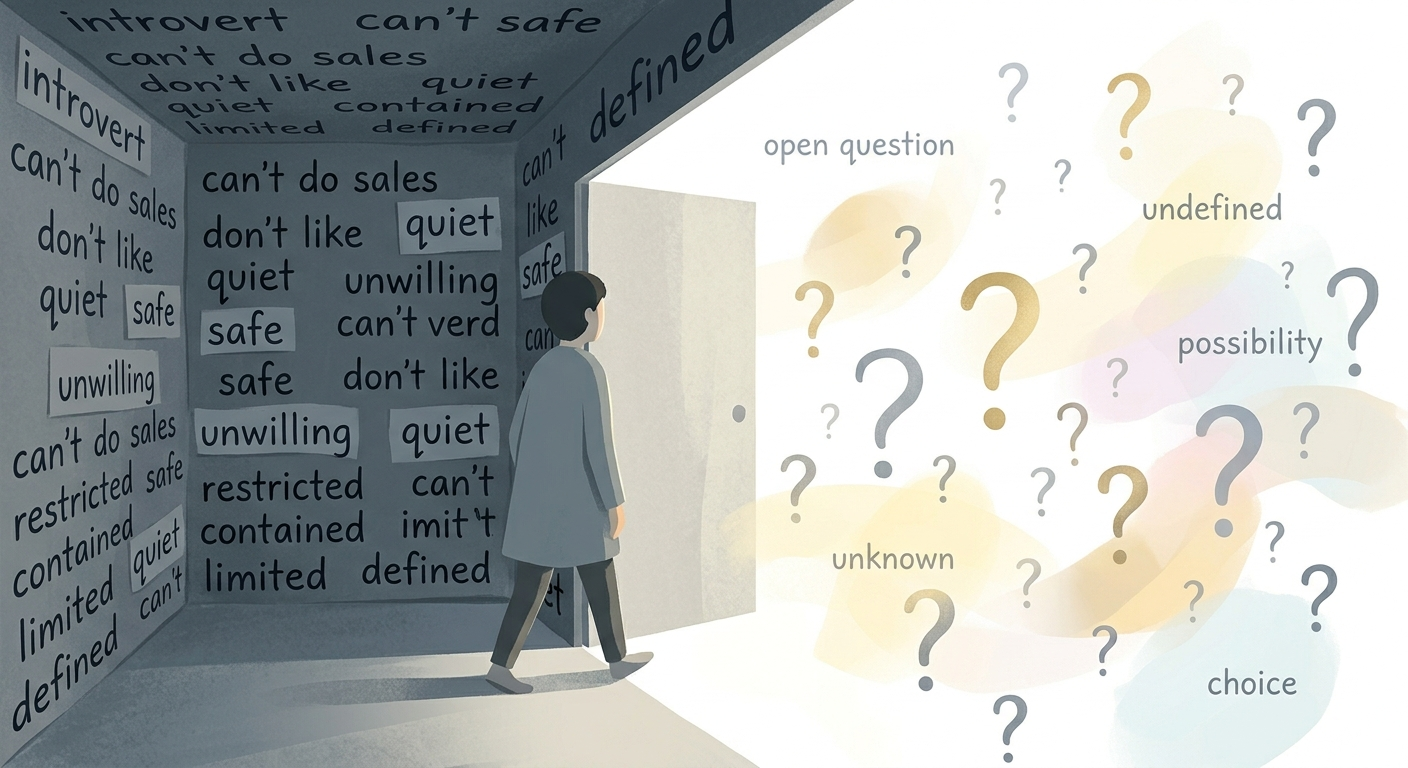
The story you build about who you are becomes a safe house.
You know the walls. You know the rooms. You know what’s inside and what’s outside. You don’t have to explore anymore. You don’t have to risk being wrong. You just say, “That’s not me,” and you’re done.
Your reality becomes the truth.
Except it’s not truth. It’s just what you decided to stop questioning.
“I’m an introvert” is easier than “Sometimes I’m extroverted when I feel safe, and sometimes I’m not, and I’m still figuring out the pattern.”
“I don’t like Chinese food” is easier than “I haven’t found the Chinese food I like yet.”
“I can’t do sales” is easier than “I haven’t learned how to sell in a way that feels aligned yet.”
The story protects you. From failure. From exposure. From having to try something unfamiliar and not know if you’ll like it.
But it also keeps you standing still.
The Gap
The gap isn’t between who you are and who you could be.
The gap is between the story you’re telling and the reality you’re living.
You say you’re an introvert, but you light up in the right room.
You say you can’t do sales, but you’ve sold things when you believed in them.
You say you don’t like something, but you never gave yourself enough tries to find out.
All true. All false. At the same time.
The story feels like safety. But it’s not safety. It’s predictability.
And there’s a difference.
Safety lets you explore. Predictability keeps you in place.
What If You Stayed Curious?
What if instead of “I can’t do this,” you said, “I haven’t figured out how to do this yet”?
What if instead of “I’m not that person,” you said, “I haven’t been that person in situations where I felt safe enough to try”?
What if instead of building a safe house out of stories, you stayed humble and curious about what you don’t know?
Not because the stories are lies. Because they’re incomplete.
My grandma laughed because she could see what I couldn’t: I wasn’t someone who didn’t like Chinese food. I was someone who hadn’t found the Chinese food I liked yet.
The story I was telling was protecting me from trying. From being wrong. From discovering something new about myself.
And that protection had a cost.
The Invitation
What stories are you telling about yourself right now?
Not the big ones. The small ones. The ones that sound like facts.
“I’m not good at…”
“I don’t like…”
“I can’t…”
What if those aren’t facts? What if they’re just the edges of your safe house?
What if your world has been getting smaller every time you say one of those sentences?
You’re not broken. You’re just standing still. Calling it truth.
And once you see that, you can decide: stay in the safe house, or step outside and find out what else is true.
I’m still discovering what’s true about me. Every time I test an old story, something new becomes possible.
That’s the gap. And that’s the compass.