Philosopher Bernard Suits said all games share one thing: the voluntary attempt to overcome unnecessary obstacles. What if your gaps work the same way?
Philosopher Bernard Suits spent years studying what makes something a game.
Chess. Football. Solitaire. Poker. What do they all have in common?
Not competition. Not winning. Not even rules, exactly.
They all share what Suits called a *lusory attitude*: the voluntary acceptance of unnecessary obstacles.
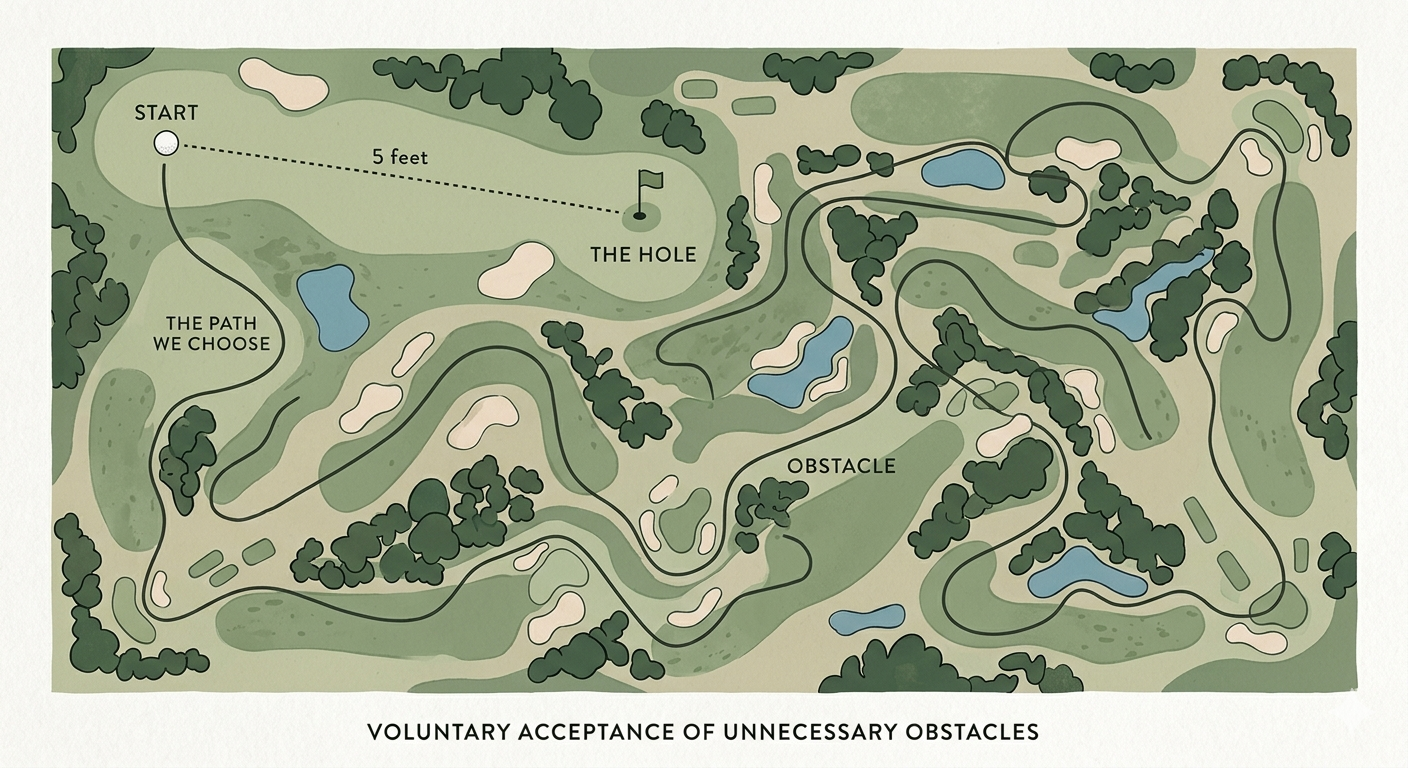
Think about golf. The goal is to get a ball into a hole. The most efficient way to do that? Walk over and drop it in.
But that’s not golf. Golf is choosing to stand 200 yards away and use a stick with a tiny metal head to hit a small ball toward a hole you can barely see. Then doing it seventeen more times.
The obstacles aren’t accidents. They’re the point. Without them, there’s no game.
We Treat Gaps Like Problems
Here’s what we do with gaps in our lives:
We try to eliminate them. Close them. Fix them. Get past them as quickly as possible.
The gap between where you are and where you want to be? That’s the problem you’re trying to solve.
The gap between what you know and what you do? That’s the failure you’re trying to overcome.
The gap between who you think you are and who you actually show up as? That’s the flaw you’re trying to fix.
We’ve turned self-improvement into a project of gap elimination. As if the goal of life is to arrive at a frictionless state where nothing stands between you and your desired outcome.
But that’s not how games work.
And I don’t think that’s how life works either.
What If the Gap Is the Game?
Bernard Suits’ insight was simple but profound: obstacles aren’t what prevent the game. They’re what create it.
You don’t play chess to eliminate the challenge of moving pieces according to arbitrary rules. You play chess *because* of those rules. The constraint is what makes it interesting.
What if your gaps work the same way?
Not problems to eliminate. But obstacles that give your life meaning. Structure. Challenge.
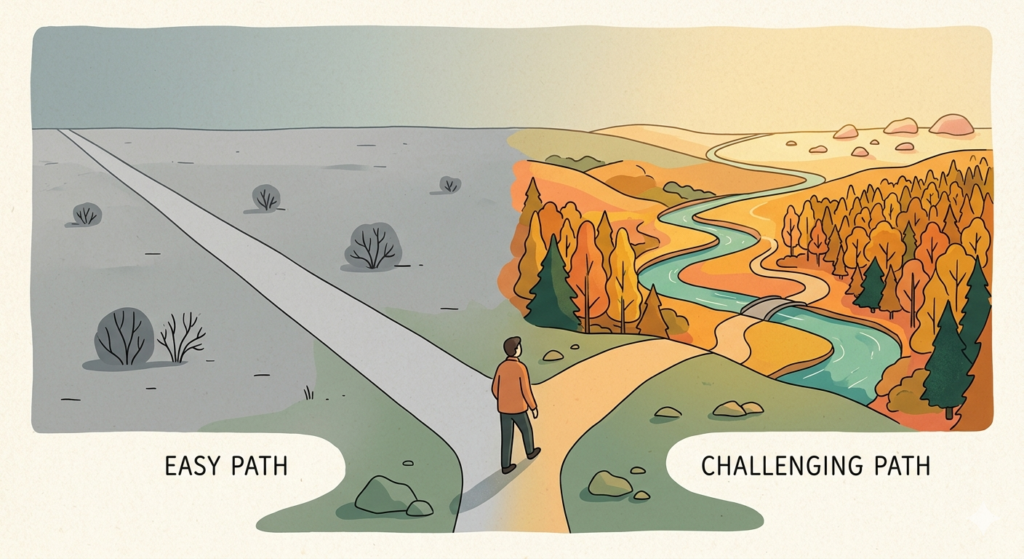
The gap between where you are and where you want to be isn’t blocking you. It’s the terrain you’re crossing. The reason the journey matters.
The gap between knowing and doing isn’t failure. It’s the space where you discover what you’re actually committed to.
The gap between who you think you are and who you show up as isn’t a flaw. It’s the invitation to keep exploring.
The Gaps I Chose
I was constantly reinventing.
Moving from one thing to the next. Family business. TBS. Your Op. Offices for You. Athena.
At the time, I didn’t see the pattern. Something would feel off and I’d move. I didn’t have language for it. I just knew I couldn’t stay.
Looking back now, I can see what I was doing: I was a player in other people’s games.
Not because those games were wrong. But because they weren’t mine.
It took me six years to find my own game. To stop playing roles in other people’s structures and start building from my own compass. (You can read that story here — [link to origin story])
Now I deliberately choose the Frontier Pioneer role. Not because I finally figured it all out. But because I’m willing to play with the obstacles that feel like mine.
That’s what a lusory attitude looks like in real life. Not perfect clarity. Just the willingness to choose your obstacles instead of enduring someone else’s.
The Obstacles You Don't Choose
Here’s where it gets tricky.
Not all obstacles are voluntary. Some are imposed. Some are inherited. Some just happen.
You don’t choose to lose someone you love. You don’t choose chronic illness. You don’t choose to be born into circumstances that make everything harder.
Those aren’t the game. Those are conditions.
But look at someone like Bibi Mentel. Leg amputated from cancer. Came back to win Paralympic gold. Not because losing her leg was a game. But because she chose how to engage with what happened to her.
Even the obstacles you don’t choose can become part of your game if you’re willing to play with them.
That’s the lusory attitude. Not naive optimism. Not pretending hard things aren’t hard. But recognizing that even within difficulty, you have agency over which obstacles you lean into and which ones you resist.
You can’t control what life hands you. But you can choose how you engage with it. Whether you treat it as something happening to you or something you’re learning to play with.
Your Gaps Are Your Compass
When I started building Win2All, people asked: “Why make it harder? Why not just tell people what their blind spots are?”
Because that’s not how it works.
You can’t tell someone their gap and expect them to see it. They have to experience it. They have to bump into it. Play with it. Discover it for themselves.
The gap isn’t something I eliminate for you. It’s something you learn to navigate. And the navigation *is* the game.
Your gaps aren’t blocking you from playing your game. They *are* your game.
The gap between what you say you value and what you actually prioritize? That’s the terrain.
The gap between the life you imagine and the choices you make daily? That’s the challenge.
The gap between knowing what to do and actually doing it? That’s where you discover what you’re really committed to.
Stop Trying to Fix Yourself
We’ve been taught that self-improvement means closing gaps. Becoming seamless. Eliminating friction between intention and action.
But what if that’s not the goal?
What if the goal is to choose your obstacles consciously? To know which gaps you’re playing with and why?
Not because gaps are fun. Not because obstacles are inherently good. But because a life without chosen challenges isn’t a game. It’s just existence.
Bernard Suits’ definition haunts me: *the voluntary attempt to overcome unnecessary obstacles.*
Unnecessary. You don’t have to engage. The obstacles aren’t required for survival. But you choose them anyway. Because without them, there’s nothing worth doing.
The Invitation
So here’s the question:
What gaps are you treating as problems to eliminate?
And what would change if you treated them as obstacles you’re choosing to play with?
Not every gap. Not every obstacle. Some things genuinely need to be fixed or released or walked away from.
But some gaps? Some obstacles?
Those are the game.
Your gap between knowing and doing isn’t failure. It’s the space where you discover what drives you.
Your gap between who you were and who you’re becoming isn’t confusion. It’s the frontier.
Your gap between what you want and what you’re willing to risk for it? That’s where everything lives.
Stop trying to eliminate your gaps.
Start choosing which ones you’re willing to play with.
Because the voluntary acceptance of unnecessary obstacles?
That’s not just what makes a game.
That’s what makes a life worth living.