Theory U maps the organizational blind spot. Here's what it looks like when you're standing in it yourself.
Otto Scharmer identified something crucial about how organizations operate: they can’t see the source from which they act. He called it the blind spot.
It’s not that organizations lack intelligence or good intentions. It’s that they’re operating from patterns, structures, and assumptions they can’t see because they’re standing inside them. The system can’t observe itself while it’s running.
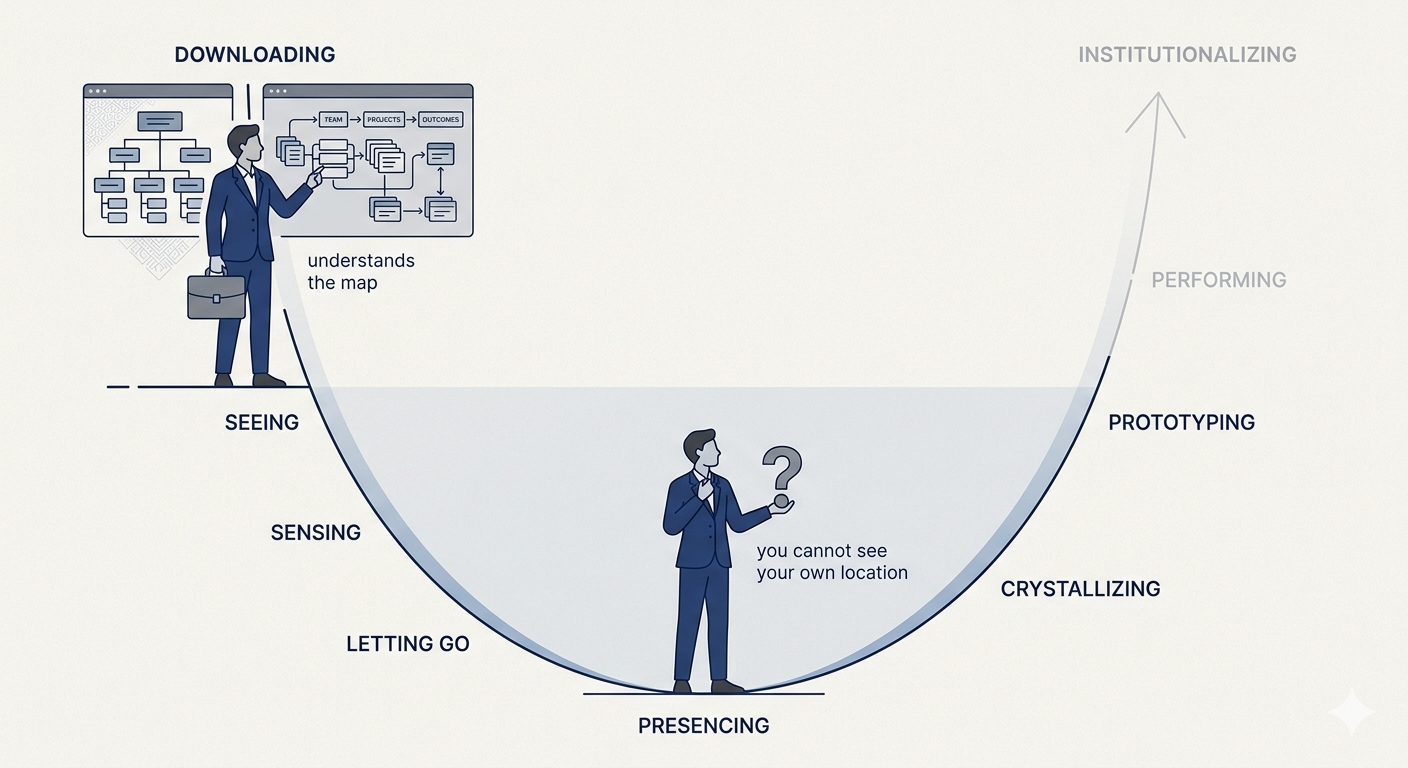
Scharmer’s work with Theory U gave us a map. A way to understand how organizations move from downloading old patterns to presencing new possibilities. It’s brilliant systems thinking.
But here’s what I’ve noticed: most people understand the concept intellectually and still don’t recognize the blind spot when they’re standing in it themselves.
Not in an organization. In their own life. On a Tuesday morning. At the dinner table. In the moment they’re making a choice they can’t see themselves making.
What the Blind Spot Looks Like at 8am
You wake up knowing you need to have a difficult conversation. You’ve known for weeks. Maybe months.
Instead, you check email. Then Slack. Then the news. Then email again.
By 9am, you’ve convinced yourself the conversation can wait. You’re busy. There’s other work that needs doing. You’ll do it when you have more clarity.
That’s not procrastination. That’s the blind spot.
You’re not avoiding the conversation because you’re weak or undisciplined. You’re avoiding it because something in you has decided that not having the conversation is safer than having it. And you can’t see that decision happening. You just find yourself busy with other things.
The pattern is running. You’re inside it. You can’t see the source from which you’re acting.
But here’s what’s even harder to see: you’re moving without knowing where you’re going. You’re busy, you’re working, you’re choosing. But toward what?
The Pattern You Can't See While You're Running It
I spent years saying “I don’t like Chinese food.”
My grandma laughed when I brought my Dutch-Chinese girlfriend home. Now my wife. And I love Chinese food.
Turns out I just didn’t like the Chinese food we were eating.
But for years, I believed my own story. Not because I was lying. Because I couldn’t see that “I don’t like Chinese food” was a story I’d built to stay safe. Safe from trying new things. Safe from being wrong. Safe from discovering I’d been limiting myself.
The blind spot isn’t the story itself. It’s that you can’t see you’re telling one.
And deeper still: I couldn’t see that I had no direction for what I actually wanted to explore. I was just saying no to things without knowing what I was saying yes to.
Scharmer saw this at the organizational level. Systems download old patterns because they can’t see they’re downloading. They think they’re responding to current reality when they’re actually replaying past conditioning.
The same thing happens personally.
You think you’re making a choice. You’re actually running a pattern you can’t see. And beneath that: you’re moving without knowing your direction.
Your Body Knows Before Your Head Admits It
I was working on the Gap Atlas when I felt it. Tension in my shoulders. Jaw set. I’d been staring at the screen for two hours without looking up.
I wasn’t tired. I was tense.
My body was telling me something my head didn’t want to hear: I was going in the wrong direction. Not wrong as in “this won’t work.” Wrong as in “this isn’t yours.”
I was performing, not playing. Building something that looked right on paper but felt off in my body.
That tension was the signal. The blind spot was that I didn’t want to listen.
But the deeper blind spot was this: I was so focused on building something, I’d stopped checking whether it was actually where I wanted to go.
Scharmer talks about presencing as the capacity to sense and actualize emerging futures. But before you can presence the future, you have to be present to what’s happening now. And most of the time, we’re not.
We’re running patterns. Defaulting to what’s familiar. Choosing the path that feels safer even when it’s not actually safe.
The blind spot is the distance between what’s happening and what we’re willing to see. And often, what we’re not willing to see is that we’re moving without direction.
Theory U Maps It. Win2All Walks It.
Here’s the thing about maps: they’re incredibly useful. They show you the territory. They help you understand where you are and where you could go.
But knowing the map isn’t the same as walking the path.
Theory U maps the journey from downloading to presencing. It’s fundamentally about orientation: finding the source from which you operate, discovering where you actually want to point yourself.
But here’s the gap most people miss: Theory U shows you how organizations need to orient themselves. It doesn’t automatically help you see where YOU need to orient.
You can understand presencing intellectually. You can describe the U-curve perfectly. You can see where your organization is downloading old patterns.
And still have no idea where your own compass is pointing. Or if you even have one.
That’s not because Theory U is incomplete. It’s because orientation isn’t something you learn about. It’s something you discover through experience.
Here’s the blind spot most people miss: you think you’re looking for clarity about WHAT you’re doing wrong.
But the actual gap is that you’re operating without direction at all.
Not “I can’t see my pattern.” But “I don’t have a compass and I can’t see that I don’t have one.”
You’re downloading, working, choosing, moving. But toward what? From what source?
That’s the orientation gap. Not that you’re going the wrong direction. That you’re moving without knowing your direction at all.
Most people get stuck at the top of the U not because they don’t understand the concept, but because they’re trying to orient themselves intellectually. They’re waiting for clarity before they move.
But orientation doesn’t come from thinking. It comes from exploring. From testing. From bumping into your gaps and discovering what they reveal about your direction.
That’s where Win2All comes in.
Theory U maps the territory. Win2All is the experiential walk through it. Not by explaining presencing, but by creating conditions where you can actually experience it. In yourself. Through play, provocation, and the moment you see: “Oh. That’s my pattern. That’s where I’ve been pointing without knowing it.”
You don’t need more understanding. You need to discover your actual orientation.
The Gap Between Knowing and Seeing
I worked with someone recently who knew Theory U inside and out. Could describe the process perfectly. Understood the concept of the blind spot at a sophisticated level.
And he was stuck. Completely stuck.
He knew he was downloading old patterns. He could see it in his organization. He could name the places where the system was running on autopilot.
But he couldn’t see that he was doing the same thing in his own leadership. Working harder instead of differently. Pushing for change while operating from the same assumptions that created the current reality.
The blind spot wasn’t that he didn’t understand Theory U. The blind spot was that he thought understanding it meant he could see his own patterns.
But deeper than that: he couldn’t see that all his hard work had no clear direction. He was pushing for change without knowing what he was actually changing toward.
Halfway through our conversation, he stopped mid-sentence.
“Oh,” he said. “I’m doing exactly what I’m describing. I can see it in the organization but I can’t see that I’m the one maintaining the pattern.”
Then, quieter: “And I don’t actually know where I’m trying to go.”
That’s the moment. Not when you learn about the blind spot. When you see yourself standing in it. When you see that you’ve been moving without direction.
What Scharmer Gave Us. What's Still Missing.
Scharmer gave us language for something organizations desperately needed to understand. The blind spot. The source from which we operate. The difference between downloading and presencing.
That work is foundational. Essential. It changed how we think about organizational change.
What’s still missing is the bridge from theory to experience.
Most people who encounter Theory U walk away thinking: “That’s brilliant. I need to do that.” And then they don’t. Not because they don’t want to. Because they don’t know how to see their own blind spot while they’re standing in it.
You can’t see the source you’re operating from while you’re operating from it. That’s the definition of the blind spot.
And you can’t see that you’re moving without direction while you’re busy moving.
So how do you see it?
Not by trying harder to see it. By creating conditions where it becomes visible. Through play. Through questions that provoke recognition rather than analysis. Through experiential moments where the pattern reveals itself. Through discovering that you’ve been moving without knowing where you’re going.
That’s what Win2All does. It doesn’t replace Theory U. It walks you through it. Experientially. One gap at a time. Starting with the most fundamental question: where’s your compass pointing?
The Invitation
If Scharmer’s work resonates with you intellectually, if you’ve read about the blind spot and thought “yes, that’s exactly what I’m dealing with,” then you already know the map exists.
The question is: are you ready to walk it?
Not theoretically. Not by studying it more deeply or understanding it more completely.
But by actually exploring your own blind spot. By making it visible. By standing in the moment where you see yourself running a pattern you couldn’t see before.
By discovering whether you even have a compass. Or if you’ve been moving all this time without one.
Theory U maps the territory. Win2All is the expedition.
Both are needed. The map without the walk is just theory. The walk without the map is just wandering.
But together, they’re how you move from downloading to presencing. From running old patterns to actualizing new possibilities. From moving without direction to discovering your actual orientation.
Not in your organization first. In yourself first.
Because you can’t lead a system through its blind spot if you can’t see your own.
And you can’t help an organization find its direction if you haven’t found yours.